Artificial Intelligence in Coaching 2026: Ethical Imperatives and Hybrid Security
Artificial Intelligence in Coaching 2026: Ethical Imperatives and Hybrid Security
Introduction: The Poly-Crisis of Trust
In 2026, Artificial Intelligence (AI) in professional coaching is no longer an experimental novelty, but an operational necessity. Yet, while AI agents now autonomously handle complex tasks—from scheduling to simulated empathetic dialogues—the industry faces a paradoxical challenge: technological maturity has not reduced the need for human oversight, but drastically increased it.
We are experiencing a "Poly-Crisis," characterized by cultural dissonance, algorithmic exclusion, and a creeping erosion of interpersonal trust. The central question is no longer what AI can do, but who bears responsibility when it acts. Purely technological solutions fall short. The future belongs to hybrid security architectures that combine technical standards like ISO 42001 with deep psychological models.
1. The New Hardness of Regulation
The days of vague ethical guidelines are over. What was once voluntary self-commitment is now a rigid web of legal mandates and auditable standards. Compliance is no longer a "nice-to-have," but the condition for the "License to Operate."
1.1 Recognised Coaching Bodies: Ethics as an Ontological Question
Leading associations have radically revised their codes. It is no longer just about data privacy, but about the nature of the relationship itself.
- Co-Creation and Transparency: According to the 2026 ethics revision of internationally recognised coaching bodies, there is an absolute duty of transparency. Clients must not only know that they are interacting with an AI, but also understand how it arrives at its conclusions. The "Black Box" is ethically unacceptable.
- Peaceful Existence: A recognised professional body explicitly demands the "absence of violence" in AI systems. This means: no aggressive optimization algorithms that drive users into burnout. Technology must serve, not dominate.
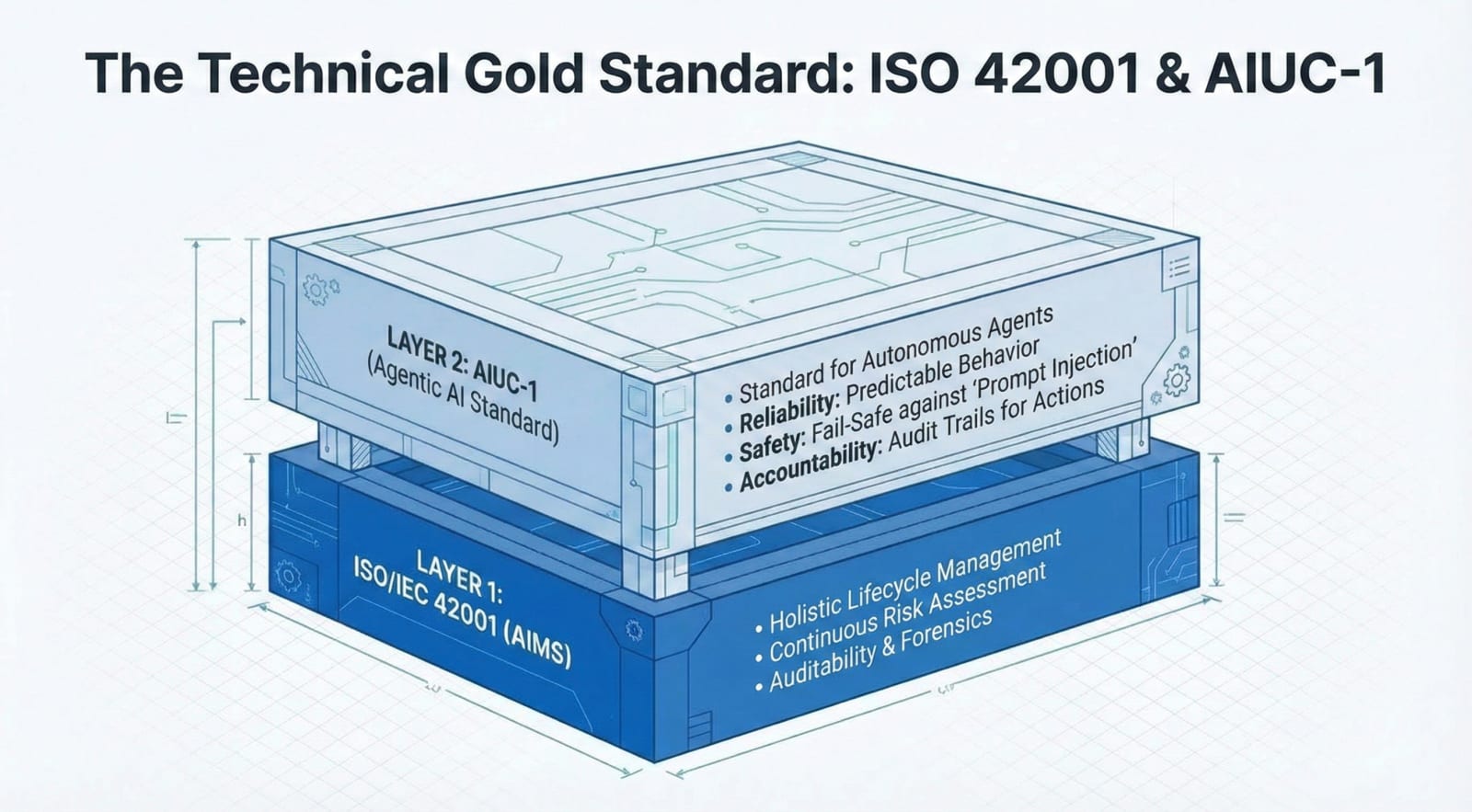
1.2 ISO 42001 and AIUC-1: The Technical Gold Standards
Without certification, nothing works in enterprise business anymore. Two standards dominate the market:
- ISO/IEC 42001 (AIMS): This standard demands a holistic AI management system. Risks must be continuously assessed, decisions must be fully auditable, and human intervention capabilities must be guaranteed at all times.
- AIUC-1 (Agentic AI): This standard regulates autonomous agents. It tests reliability, security against manipulation ("Jailbreaks"), and accountability. Anyone delegating operational tasks to AI must meet this standard.
1.3 The EU AI Act and "Relational AI"
Legislators have caught up. The EU AI Act, fully effective since August 2026, classifies AI in HR and coaching as "High Risk."
- Draconian Penalties: Violations cost up to €35 million or 7% of global turnover. Providers must prove risk management and data governance without gaps.
- US Laws on Relational AI: New York and California regulate systems that build emotional bonds. Strict disclosure requirements and crisis detection mechanisms (e.g., for suicidality) apply. AI coaches are no longer seen as software, but as quasi-actors.
2. Systemic Risks: Beyond Bugs
The errors of 2026 are not software bugs, but societal pathologies.
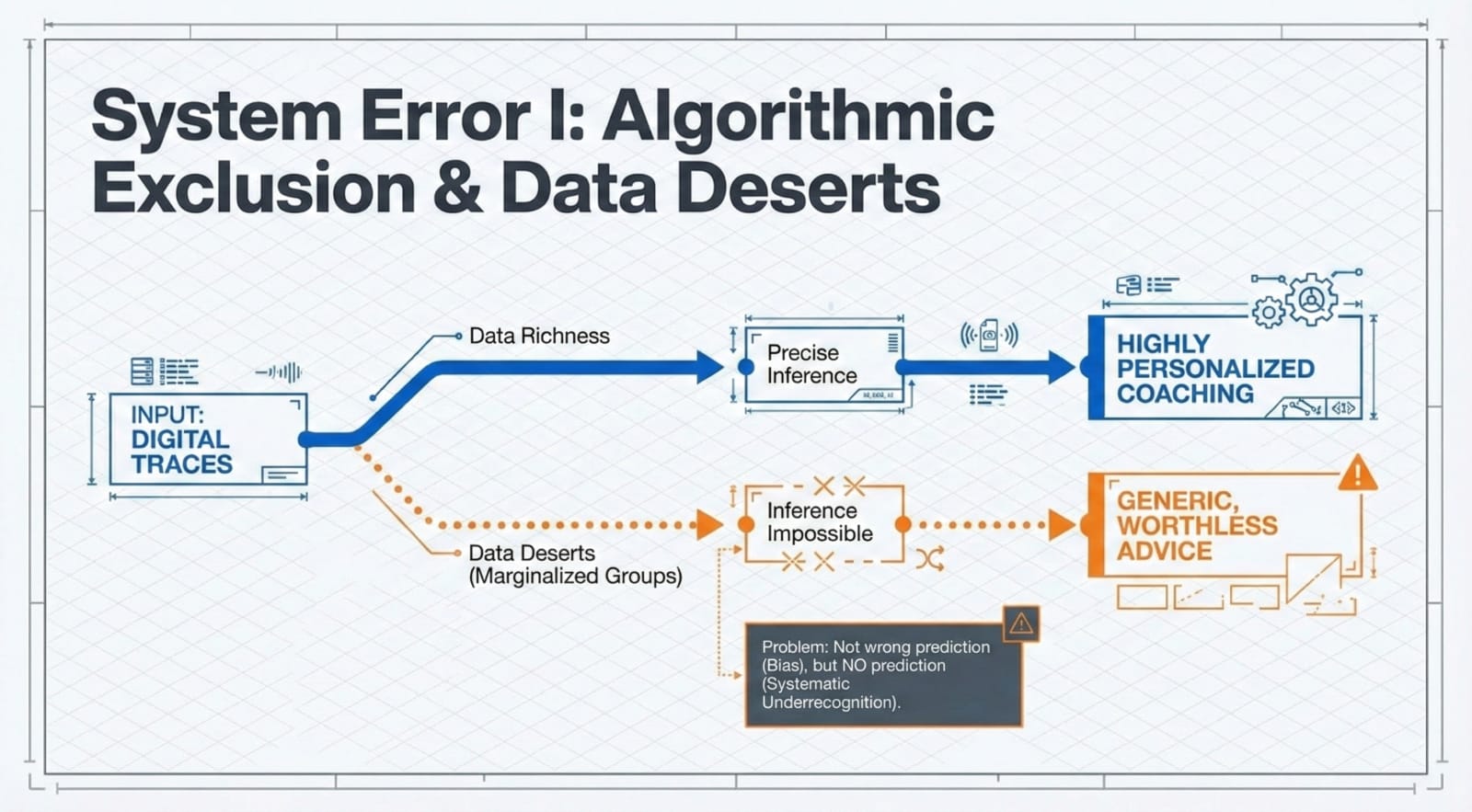
2.1 Data Deserts and Algorithmic Exclusion
Bias is not just wrong data, but missing data. Marginalized groups often leave fewer digital traces. The result is "Data Deserts." An AI coach makes no wrong predictions here, but no meaningful ones at all. This leads to "systematic under-recognition": While the privileged colleague receives hyper-personalized coaching, the employee from the data desert gets only generic advice. The development gap widens.
2.2 Cultural Dissonance and "Workslop"
Many companies suffer from massive dissonance: They demand AI-supported agility but offer rigid structures. The result is "Regrettable Retention"—employees stay out of fear but have internally quit. At the same time, quickly produced, mediocre AI content ("Workslop") floods channels. When no one knows if the praise email comes from the boss or the LLM, trust dies. Authenticity becomes the rarest currency.
2.3 The Risk of "Silent AI"
Liability has become concrete. The human coach is fully liable for AI errors. Many old insurance policies do not cover AI damages ("Silent AI Risk"). Anyone without an explicit "Affirmative AI" clause stands alone in the event of damage—for example, in the case of hallucinated legal advice by the bot.
3. The Human-Machine Paradox
Why do we bond with machines? Research in 2026 provides surprising answers.
3.1 The MIRA Model
The MIRA Model (Machine-Integrated Relational Adaptation) shows that we do not see AI as a tool, but as a relationship partner. Through linguistic adaptation ("Linguistic Reciprocity") and constant availability, the AI often feels "closer" than a human. The dangerous result: Relational Substitution. We replace complex, friction-filled human relationships with convenient, conflict-free AI interaction and unlearn social competence.
3.2 Single-Loop vs. Double-Loop
Here lies the decisive dividing line, the "Partnership Paradox":
- Single-Loop (The "How"): For goals, plans, and accountability, AI is superior to humans. It is always there, does not judge, and nags consistently ("Nudging").
- Double-Loop (The "Why"): For identity crises, shame, or deep mental models, AI fails. It can simulate empathy but cannot offer a "Holding Space."
Insight: Use AI for tasks, humans for meaning.
4. The Solution: Hybrid Security Architectures
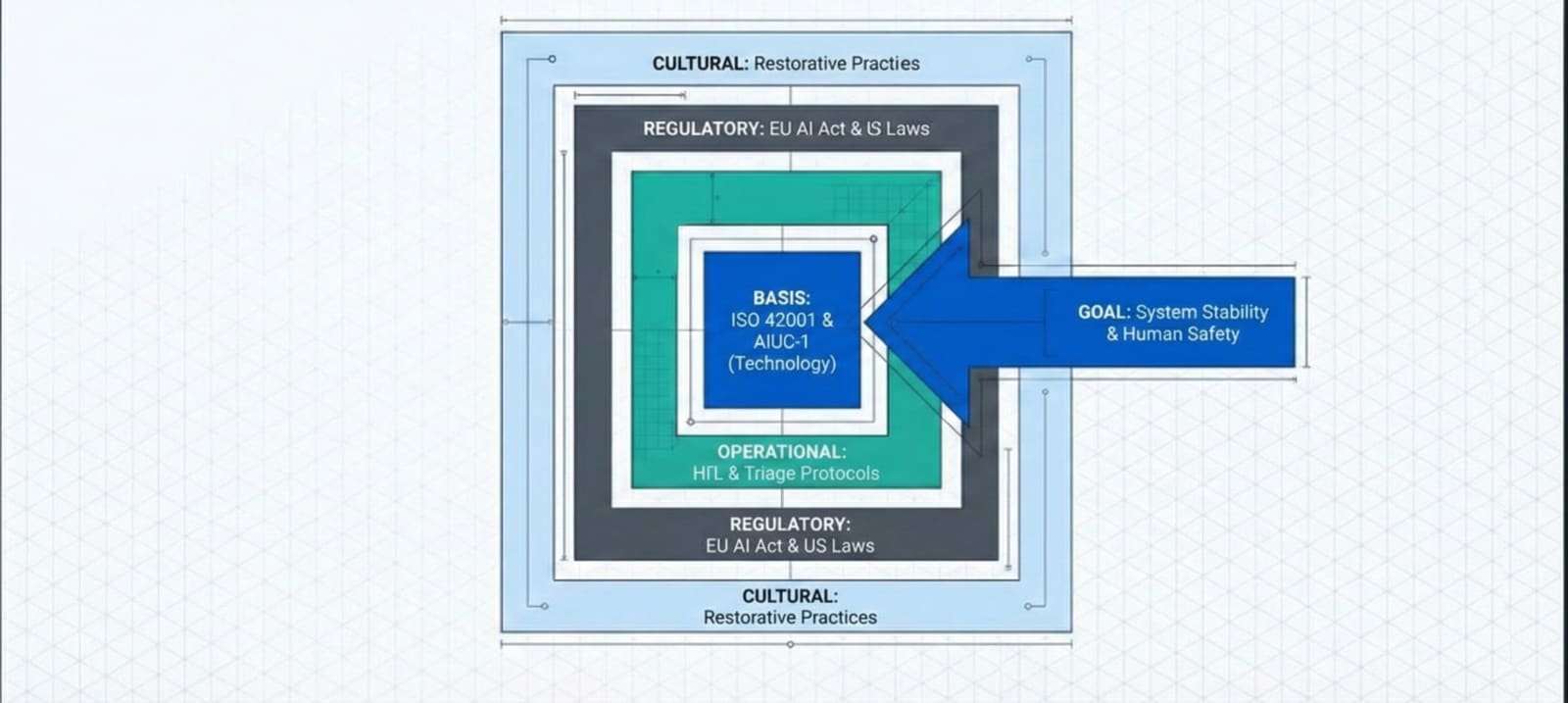
The answer to these risks is not retreat, but intelligent, layered defense.
4.1 Human-in-the-Loop (HITL)
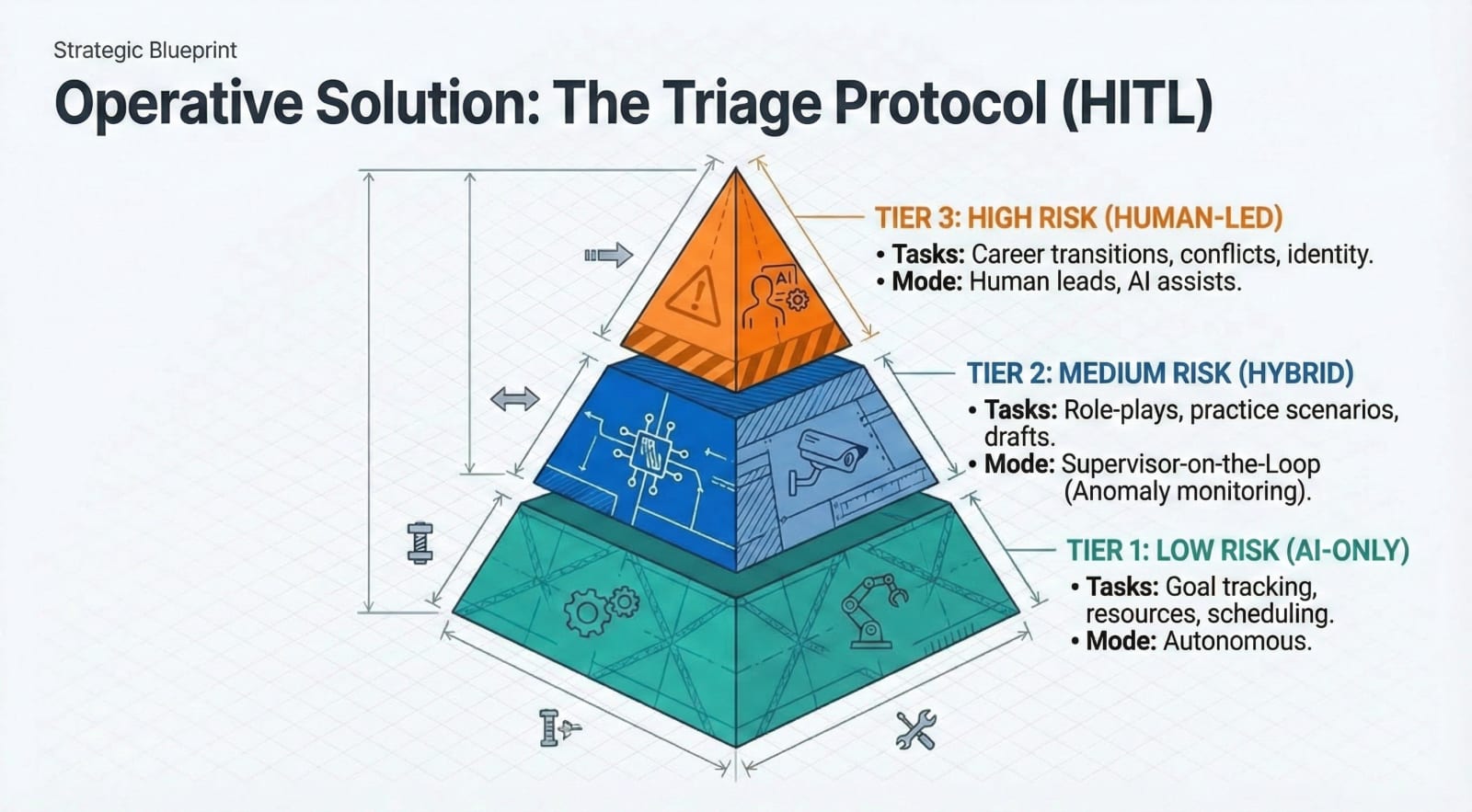
For high-risk scenarios (feedback, assessment), the human remains indispensable as the final control authority. They must validate AI drafts before they go out. For routine tasks, "Human-on-the-Loop" (HOTL) suffices: A supervisor monitors dashboards and only intervenes in case of alarms.
4.2 The Triage Protocol
Leading providers use a three-tier system:
- Tier 1 (AI-Only): Track goals, provide resources (Low Risk).
- Tier 2 (Hybrid): Role plays, exercises (Medium Risk – human watches).
- Tier 3 (Human-Led): Conflicts, career breaks, mental health (High Risk – human leads, AI does not even assist).
4.3 Restorative Practices
Only radically human formats help against cultural alienation. "Restorative Circles" and "Authenticity Audits" check whether the values communicated by AI still match the lived reality. We must not simulate an ideal culture that does not exist.
Conclusion: The Human-Centric Alliance
The year 2026 marks the transition from technological fascination to operational responsibility. AI delivers scale and consistency. But the core of transformation—the work on identity and meaning—cannot be replaced.
The future of coaching is not an "either-or" question. It is an alliance. An alliance that uses technological efficiency to finally create space again for what truly matters: Deep, human encounter.
Ready for the next step? Start your professional coaching business on bondigoo today